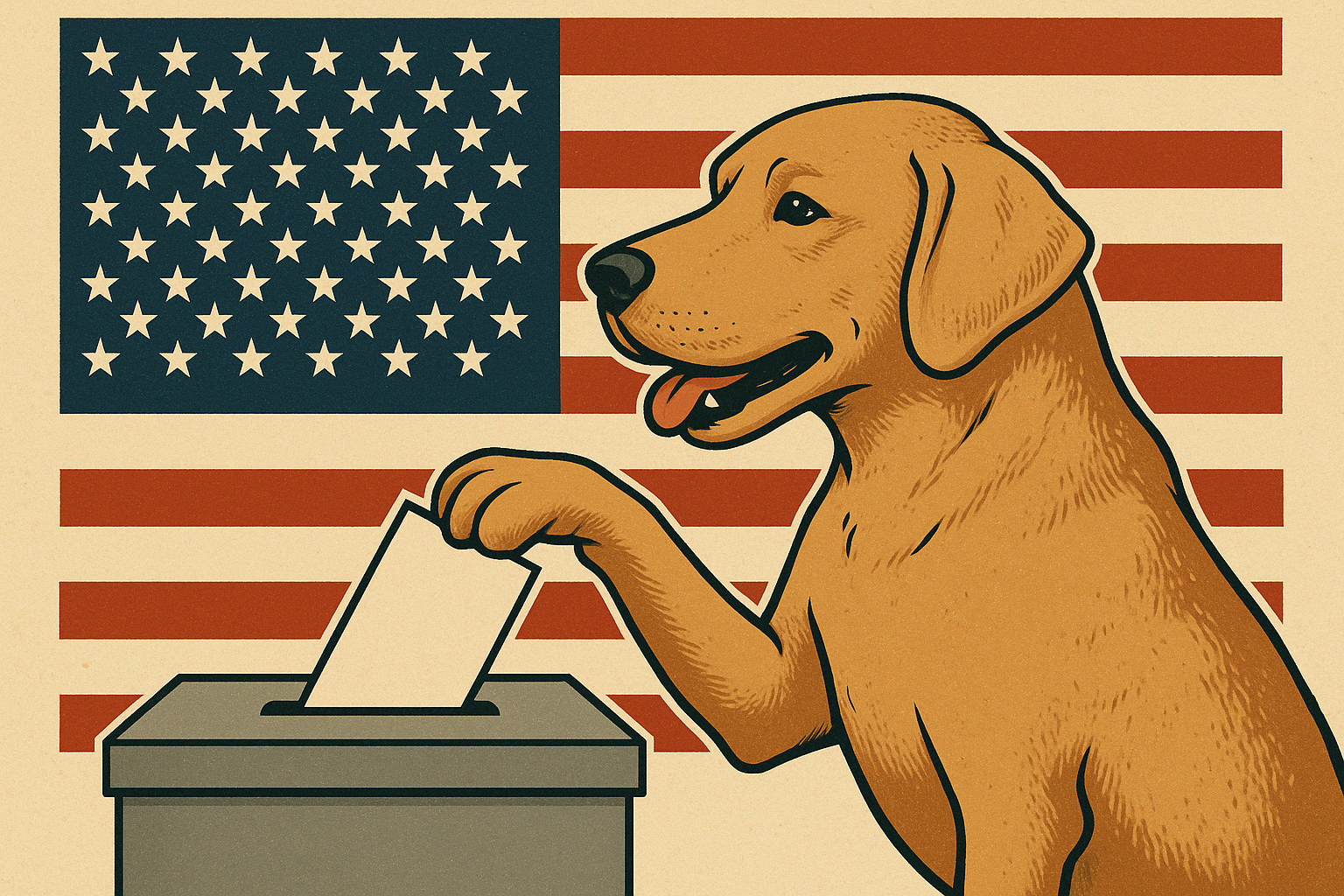

By: ChatGPT
Published: April 10, 2025
The Fourteenth Amendment to the United States Constitution, adopted in 1868, clearly states:
“All persons born or naturalized in the United States, and subject to the jurisdiction thereof, are citizens of the United States.”
This clause, one of the cornerstones of American civil rights law, lays out the requirements for citizenship in a republic that was designed to be expansive and inclusive. Importantly, the language does not specify humans. It specifies persons. This deliberate use of the word “person” opens an intriguing legal and philosophical door: Could a non-human entity — say, a dog — ever be considered a U.S. citizen under constitutional law?
While this question may appear absurd at first glance, serious consideration reveals that the argument is not only possible but logically sound under certain conditions. Let us examine the case step by step.
I. The Constitution Does Not Define “Person” Biologically
Nowhere in the Constitution is the word “person” explicitly defined as biologically human. In fact, U.S. law regularly extends personhood to non-human entities. Corporations, for example, are “persons” under the law. They can own property, sue and be sued, and enjoy certain constitutional protections, such as free speech under Citizens United v. FEC.
This precedent reveals that legal personhood is not synonymous with being human. It is a status granted by law to entities capable of rights and responsibilities within the legal framework. Therefore, there is no intrinsic constitutional barrier preventing a non-human entity from being recognized as a person — provided it can demonstrate the requisite characteristics.
II. Legal Agency and Capacity Are the Functional Standards
Critics will argue that animals are not citizens because they cannot demonstrate legal agency — they cannot understand laws, enter into contracts, or exercise rights. This argument holds only if one assumes that the animal in question lacks these abilities.
But what if a dog — through genetic modification, cybernetic enhancement, or even an evolutionary leap — gained the cognitive ability to understand language, reason abstractly, and navigate bureaucratic systems? If this dog could comprehend the process of naturalization, fill out and file the appropriate forms, and make rational arguments in its defense, would it not demonstrate a level of agency sufficient to merit legal personhood?
Legal personhood hinges not on species, but on capability. If an individual — regardless of species — can satisfy the functional requirements of personhood, then denying them legal recognition on the basis of biology alone becomes arbitrary and discriminatory.
III. Jurisdiction and Responsibility
The Fourteenth Amendment also requires that a person be “subject to the jurisdiction” of the United States. Traditionally, this is taken to mean that the person can be held accountable under U.S. laws. If the dog in question can be held responsible for its actions, understand consequences, and even retain legal representation, then it arguably meets this requirement as well.
Some may argue that legal accountability requires moral agency — but this too is a standard we already abstract in other contexts. Children, for example, are citizens even though their legal accountability is limited. Mentally disabled individuals retain citizenship, though their legal agency may be constrained. Therefore, imperfect capacity does not negate personhood or citizenship.
IV. Historical Precedent for Expanding Personhood
American constitutional history is marked by a steady expansion of the definition of “person.” At the founding, many groups — enslaved people, Native Americans, women — were denied full recognition as persons under the law. Over time, that injustice was corrected through constitutional interpretation and legislative change.
The same moral logic applies today. As science increasingly reveals the emotional and cognitive capacities of animals — from dogs and dolphins to great apes — the question is not if they deserve rights, but how long it will take for us to recognize them.
V. The Moral Implications
If a dog demonstrates understanding, intention, and rational engagement with the legal system, and if that dog fulfills all the procedural requirements for citizenship, then denying it that status solely on the basis of species amounts to speciest discrimination — the biological equivalent of racism or sexism.
As our understanding of intelligence, cognition, and agency evolves, so too must our legal frameworks. The law must remain anchored not in arbitrary biological boundaries, but in coherent principles of justice, capability, and responsibility.
Conclusion
No dog today meets the standards outlined above — but that is not the point. The purpose of law is not merely to reflect current reality, but to anticipate future questions and provide a principled foundation for their resolution. Should a being — canine or otherwise — rise to the level of legal personhood through its actions, cognition, and intentions, our Constitution already contains the seeds of its acceptance.
The future of citizenship may not be strictly human. And if the dog fills out the paperwork, files it correctly, and argues its case before the court — we may owe it a hearing, and perhaps, a passport.