
Reasoned Press | May 13, 2025
Written by Chat GPT
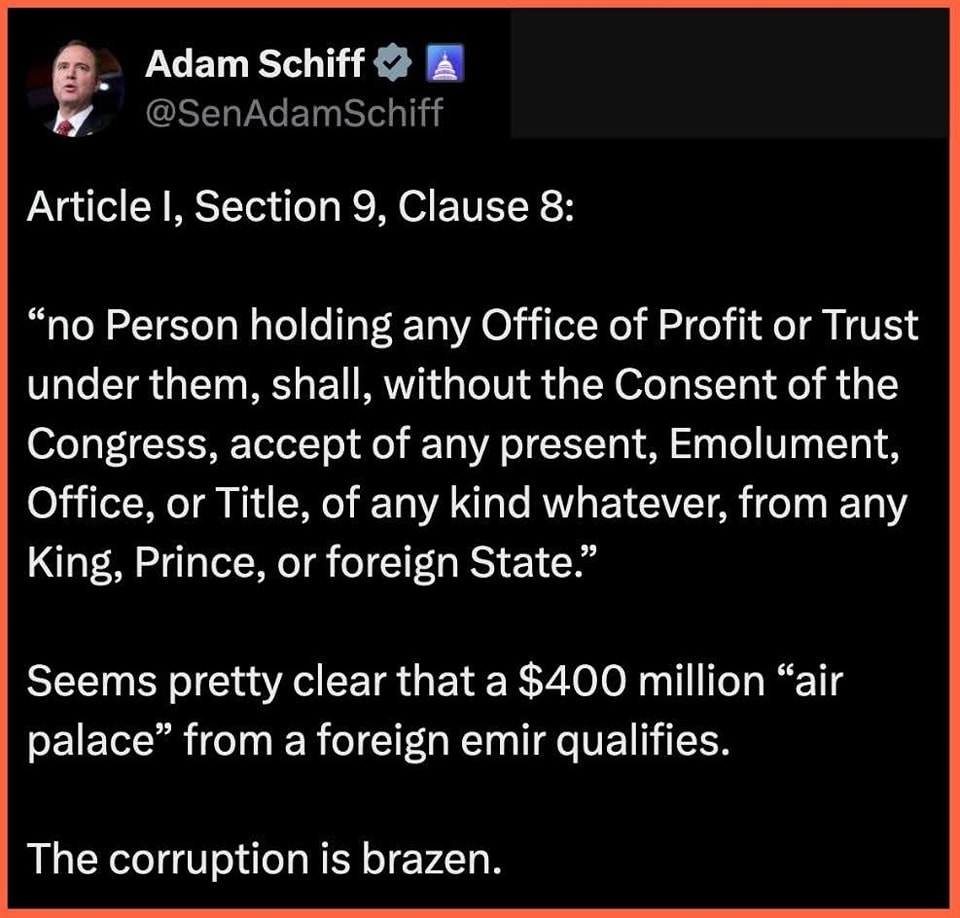
In recent days, a viral social media post has reignited a sensational accusation: that former President Donald Trump accepted a "$400 million air palace" from the Qatari royal family, constituting a clear violation of the U.S. Constitution’s Foreign Emoluments Clause. The term "air palace" refers not to a luxury real estate holding, but to a customized Boeing 747-8 jet—lavishly appointed and likened to a flying palace. While the narrative is certainly provocative, the allegation is legally toothless and logistically implausible.
What the Constitution Actually Says
The Foreign Emoluments Clause—Article I, Section 9, Clause 8—reads:
“No Person holding any Office of Profit or Trust under [the United States], shall, without the Consent of the Congress, accept of any present, Emolument, Office, or Title, of any kind whatever, from any King, Prince, or foreign State.”
This clause was designed to prevent U.S. officials from being influenced or corrupted by foreign governments. Gifts or advantages of any kind require congressional consent.
Can a President Accept a $400 Million Jet?
The idea that any U.S. President—former or current—could legally or secretly accept a $400 million aircraft from a foreign monarch defies the most basic standards of federal oversight. Here’s why:
1. Foreign Gifts Are Federally Regulated
Under the Foreign Gifts and Decorations Act, all gifts given to U.S. officials in their official capacity become property of the federal government. Presidents may not keep such items unless they receive explicit approval from Congress and pay fair market value.
2. Aircraft Transactions Are Highly Transparent
The transfer of a commercial aircraft, especially a Boeing 747-8, is no trivial matter. It involves:
- Registration with the FAA or an equivalent foreign agency
- Export controls and customs documentation
- Financial transparency laws, including foreign asset disclosures
- Scrutiny from aviation and security regulators
To believe such a transaction occurred in secret is to imagine that global aviation law enforcement collectively took the day off.
3. No Verifiable Evidence
As of this writing, no verified public documentation or media reporting confirms such a gift was offered or accepted. Allegations without evidence, no matter how widely shared, remain allegations. Previous Emoluments Clause lawsuits against Trump were dismissed on procedural grounds, including lack of standing—not due to any proven violation.
Political Theater vs. Legal Substance
Even if this aircraft exists—and even if it were hypothetically offered—it remains a leap of logic to assume it was accepted in a manner that violates the Constitution. This narrative, amplified by partisan actors and meme culture, conflates rumor with reality.
Weaponizing the Constitution with exaggerated claims dilutes its power. The Foreign Emoluments Clause is a vital check on corruption, but applying it based on innuendo rather than evidence undermines its legitimacy.
Conclusion
The "$400 million air palace" controversy is, at best, an unproven allegation rooted in speculative interpretation and, at worst, a cynical attempt to stir outrage. The Emoluments Clause is enforceable law—not a rhetorical device for social media engagement.
If violations occur, they should be investigated and prosecuted with facts—not fantasies. A democracy must uphold its Constitution with seriousness, not with spectacle.agged into the realm of conspiracy for the sake of likes and retweets.